
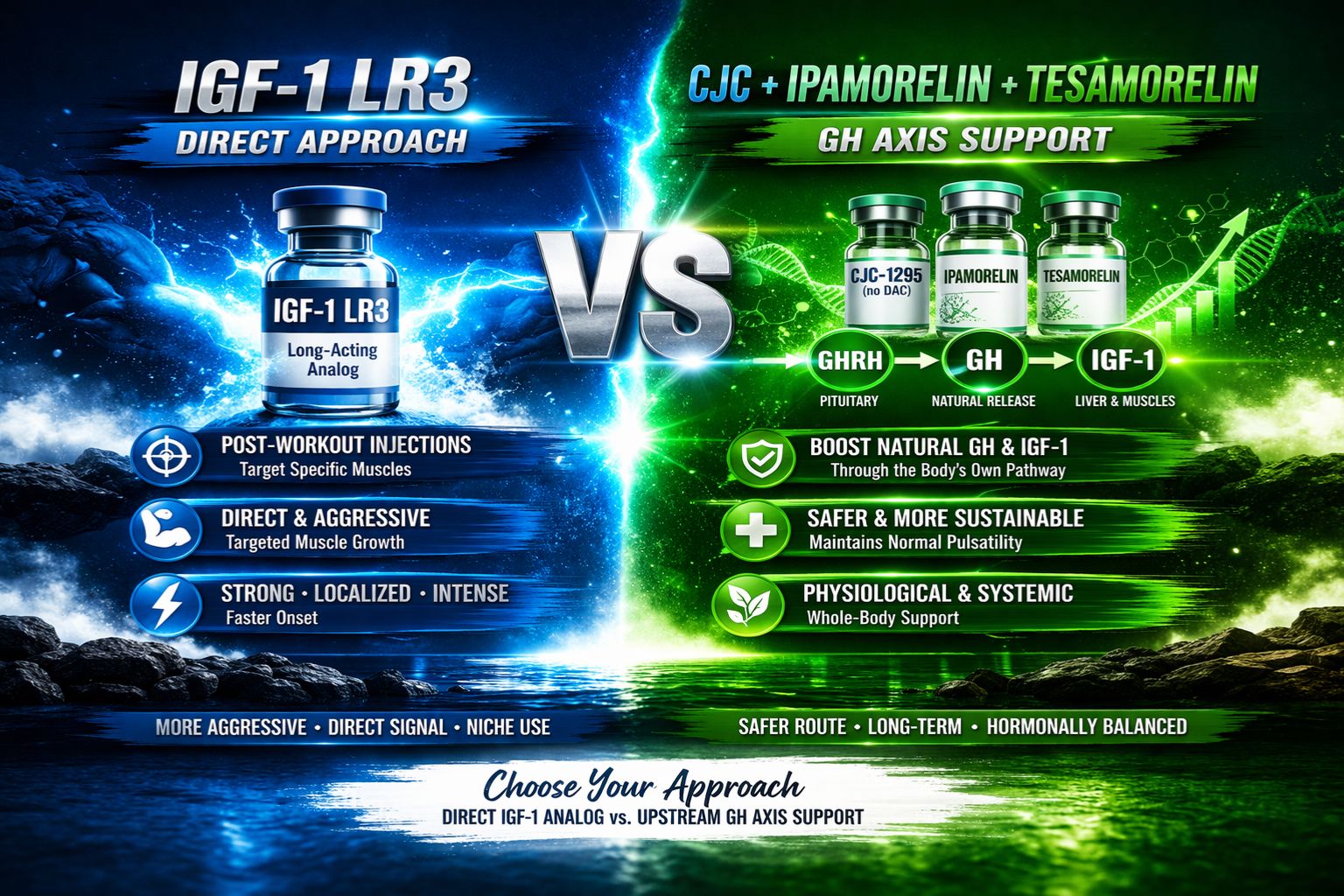
Few compounds create as much debate in bodybuilding circles as IGF-1 LR3. For years, it has been discussed as a more aggressive way to push anabolic signalling, often with the older-school idea that it should be used around training and even aimed at lagging muscle groups. More recently, the conversation has shifted. Instead of asking whether IGF-1 LR3 can be used more directly, more people are asking whether it makes more sense to support IGF-1 indirectly through the GH axis using compounds such as CJC-1295, Ipamorelin, and Tesamorelin. That is a much smarter discussion, because it forces a comparison between direct endpoint signalling and upstream physiological support.
That distinction matters because IGF-1 biology is both local and systemic. Muscle produces local IGF-related signals in response to loading and repair, but that does not automatically prove that injecting an exogenous IGF analogue into a trained muscle creates reliable site-specific growth in real-world human use. At the same time, the GH axis is a normal upstream driver of systemic IGF-1 production, which is why compounds that increase GH signalling are often easier to position as the more physiology-led alternative.
Overview
- Category: Performance and anabolic signalling comparison
- Best suited for: Those comparing direct IGF analogue use with indirect GH-axis support
- Main question: Is IGF-1 LR3 the better bodybuilding route, or is upstream IGF support the cleaner option?
- Main counterpoint: CJC-1295 + Ipamorelin + Tesamorelin as a more physiological route to higher IGF activity
- Core tension: Direct signal versus body-led hormone cascade
- Experience level: Best suited to those already familiar with advanced stack logic
What Is IGF-1 LR3?
IGF-1 LR3 is generally discussed as a modified IGF-1 analogue used when the goal is a more direct anabolic signal. That is what gives it such strong appeal in bodybuilding culture. Instead of working upstream and relying on the body to raise IGF-1 through growth-hormone signalling, LR3 is talked about as the harder, more deliberate route. It is the compound people reach for when they want the discussion to be about directness, not subtlety.
That said, direct does not always mean cleaner or more precise. The attraction of LR3 rests on the importance of IGF-1 in growth signalling, but once exogenous IGF is introduced, the story becomes more complex. Delivery, tissue access, and systemic spillover all matter, which is one reason IGF-based interventions are harder to treat as neat, muscle-specific tools than bodybuilding lore often suggests.
How It Works
The appeal of IGF-1 LR3 comes from the fact that IGF-1 sits close to the center of muscle growth signalling. That is why the older bodybuilding culture around it became so strong. The logic was simple: train a muscle hard, create local demand, then use a direct IGF-related compound around that window to support growth more aggressively. It is easy to understand why that idea took hold.
But the stronger scientific support is for the broader principle that IGF pathways matter in muscle adaptation, not for the specific gym claim that post-workout local use reliably creates superior spot-targeted hypertrophy in human practice. That is exactly where the newer comparison becomes more valuable. Instead of asking whether LR3 can be used as a site tool, it is more useful to ask whether it is better to support IGF by working upstream through GH release.
Why Choose This Product?
The classic bodybuilding reason for choosing IGF-1 LR3 is that it is seen as the more aggressive route. It appeals to those chasing a stronger direct signal and a more old-school “push the pathway” logic. That is why it became associated with post-workout use, lagging body-part talk, and a more forceful bodybuilding identity.
The real counterpoint, though, is not some vague “other mechanism.” It is a deliberate GH-axis support stack built around CJC-1295, Ipamorelin, and Tesamorelin. That stack works differently. Instead of supplying a direct IGF analogue, it supports the hormonal cascade that leads to increased GH output and, downstream, increased IGF-1. Human studies show CJC-1295 can raise GH and IGF-1 while preserving pulsatile GH secretion, Ipamorelin has been described as a selective GH secretagogue with strong specificity for GH release, and Tesamorelin has shown physiologic increases in IGF-1 together with favorable body-composition effects in clinical trials.
That is why CJC + Ipamorelin + Tesamorelin is the cleaner alternative in this discussion. It does not have the same “hard signal” mystique as LR3, but it is much easier to frame as the safer, more sustainable, and more physiology-led route. Growth hormone secretagogues also tend to preserve feedback-regulated pulsatility rather than simply forcing the endpoint directly.
Best Use Cases
IGF-1 LR3 as the Older Bodybuilding Route
The traditional use case for LR3 in bodybuilding was a more aggressive one: hard training, a post-workout window, and sometimes a body-part emphasis. Whether or not that logic has been overstated, that is how the product built its reputation. It has always appealed most to those who want the conversation to center on direct signalling.
CJC + Ipamorelin + Tesamorelin as the Smarter Counterpoint
Where the goal is not just to push harder but to build a more defendable strategy, CJC + Ipamorelin + Tesamorelin makes far more sense as the comparison point. CJC-1295 acts as a long-acting GHRH analogue, Ipamorelin helps support GH release via the ghrelin receptor pathway, and Tesamorelin offers another clinically studied GHRH-based route that meaningfully raises IGF-1. Together, they support the axis upstream rather than forcing the endpoint.
Bodybuilding vs Broader Support Logic
If the conversation is purely old-school bodybuilding, LR3 will always seem more intense. If the conversation is about overall stack logic, longer-term hormonal support, recovery, body composition, and cleaner physiology, the CJC/Ipamorelin/Tesamorelin route is much easier to justify.
Typical Dosing Approach
For this kind of article, the useful distinction is not exact protocol numbers but how the two routes are generally positioned.
IGF-1 LR3 is usually discussed as the more direct and aggressive route. It is framed in bodybuilding culture as something more deliberate, more pointed, and more tied to traditional anabolic intent.
By contrast, CJC-1295 + Ipamorelin + Tesamorelin is better understood as a stack architecture, not a blunt instrument. It is generally positioned as the steadier route for those trying to support the GH–IGF axis more naturally, with better logic for longer-form recovery, composition, and hormonal-support strategies. That is part of why it reads as the safer counterpoint rather than just a weaker version of the same idea.
What Is Commonly Experienced?
From a bodybuilding perspective, the attraction of IGF-1 LR3 is the expectation of a stronger and more direct anabolic signal. That is why it still carries such a powerful reputation. But the cleaner and more defendable claim is simply that IGF signalling is important in muscle adaptation — not that every traditional gym-use pattern around LR3 is proven or reliably superior.
The CJC + Ipamorelin + Tesamorelin route feels different conceptually. It is less about forcing a sharp endpoint and more about creating a broader hormonal environment that supports recovery, body composition, and downstream IGF-1 elevation through mechanisms the body already uses. That is one reason it is often the more comfortable route to discuss when safety and sustainability matter, not just aggressiveness.
Common Stack Pairings
IGF-1 LR3
Historically grouped with more aggressive bodybuilding logic, especially where the conversation centers on pushing growth signalling as directly as possible.
CJC-1295 + Ipamorelin + Tesamorelin
A far better fit for a GH-axis support strategy. This combination gives the article a true counterpoint because it is not just “another peptide option.” It is a different philosophy of use: instead of direct IGF analogue exposure, it supports GH release and downstream IGF production through an upstream route.
Things to Keep in Mind
This is where the difference between the two approaches becomes most important. Direct IGF exposure is the harder route to defend from a safety standpoint. FDA labeling for mecasermin, a medical recombinant IGF-1 product, warns about severe hypoglycemia, including hypoglycemic seizures, because of insulin-like effects. That does not mean IGF-1 LR3 is the same product, but it is a very relevant warning about the broader risk profile of direct IGF-1 exposure.
By contrast, CJC-1295, Ipamorelin, and Tesamorelin sit upstream. That does not make them risk-free, but it does make them easier to position as the more physiological route. CJC-1295 has human data showing increased GH and IGF-1 with preserved pulsatility, Ipamorelin has been described as selective for GH release without the same cortisol spillover seen with older secretagogues, and Tesamorelin has clinical data showing physiologic IGF-1 increases and body-composition benefits in studied populations.
So the practical summary is simple:
IGF-1 LR3 remains the more aggressive, more niche, harder-edged option.
CJC-1295 + Ipamorelin + Tesamorelin is the clearer safer-route counterpoint because it supports the pathway upstream rather than forcing the endpoint directly.
Who It Suits Best
This article is best suited to those trying to understand the difference between old-school direct-growth logic and modern axis-support logic.
For the more aggressive bodybuilding mindset, IGF-1 LR3 will always attract interest because it represents the direct route. For those looking at the bigger picture — physiology, longer-term sustainability, and a cleaner safety discussion — CJC-1295 + Ipamorelin + Tesamorelin is the stronger and more measured comparison point.
Final Take
The old-school view of IGF-1 LR3 as a post-workout, target-muscle tool is deeply embedded in bodybuilding culture, and that is not going away. But once the discussion becomes more serious, the real counterpoint needs to be explicit: CJC-1295 + Ipamorelin + Tesamorelin is the more physiology-led route to supporting higher IGF activity. Human evidence supports GH and IGF-1 increases with CJC-1295 and Tesamorelin, while Ipamorelin is widely positioned as a selective GH secretagogue that fits naturally into that axis-support logic.
So if the goal is the more aggressive and direct route, IGF-1 LR3 remains the harder-edged option. If the goal is a route that is easier to defend in terms of safety, sustainability, and overall stack logic, then CJC-1295 + Ipamorelin + Tesamorelin is the stronger final answer.
